Showing posts with label History. Show all posts

Thursday, June 11, 2015

A lunchtime walk to Japantown in the heart of Salt Lake City

"It is impossible to remain indifferent to Japanese culture. It is a different civilisation where all you have learnt must be forgotten. It is a great intellectual challenge and a gorgeous sensual experience."
~Alain Ducasse

Now don't get too excited. Japantown in Salt Lake is a whole lot different than it is in San Francisco. In fact it's quite a ghost of what it once was about fifty, seventy-five, even a hundred years ago. You'd likely miss it if you didn't know it was there. The area consists now of one block of 100 South between 200 and 300 West and I walked there for today's lunchtime walk.


The only buildings left to remind us of a bygone era are the Salt Lake Buddhist Temple and the Japanese Church of Christ, which was placed on the National Register of Historic Places in 1982.

The rest of the block feels pretty desolate and is comprised of parking lots, the Salt Palace storage and loading docks, a bookstore/gift shop associated with the Buddhist Temple called Lumbini's Garden, and a small Japanese-style garden which was incorporated into the block when the Salt Palace made extensive expansions into what used to be a bustling neighborhood.


The Japanese Church of Christ, built in 1924, is on the north west side of the block, closest to 300 West.


The Japanese-style garden, though oddly wedged between the Church of Christ and a underground parking lot entrance, is quite cute and very zen. Walking in the garden is not permitted, but I enjoyed seeing several trees (Japanese maples and bonzai types) with ropes tethered to stakes in the ground, training them to grow sideways instead of up.


Just east of the parking lot which borders the garden, are tall walls with attempting to hide the Salt Palace loading and storage docks. The gates that have been put up all along the rest of the north side of the block to 200 West are called the Kimono Gates.


Again, a nice touch by the Salt Palace -- despite taking over much of the land after the city's residents overwhelmingly voted to approve a 17 million dollar bond to build the Salt Palace complex in 1964 -- to help the Japanese culture endure in the area and to honor those who lived and worked in generations past where these structures now stand.

On the southeast corner of the block sits the Salt Lake Buddhist Temple.


I was glad to see at least some preservation of what used to be a vibrant neighborhood. But, of course, I was sad to know of what used to be there: a Japanese language school, a produce market, a fish market, two thriving newspapers, a tailor's shop, the Colonial Hotel, and countless families of Japanese descent.

In a city where the Mormon pioneers and their stories dominate historical discussions, seldom is anything heard about the strong, compassionate Japanese community, numbering in the thousands, which endured generations right in the heart of the state's capital city.

I hope since the naming of the street, Japantown Street, which happened in 2007, that eventually sometime soon, at least the empty above-ground parking lot on the southwest half of the block will be turned into land for businesses, restaurants. One can hope!
.
.
.
.

Monday, June 08, 2015

Lunchtime Walk to Union Pacific Depot

"The camera makes everyone a tourist in other people's reality, and eventually in one's own."
~Susan Sontag

Working in downtown Salt Lake City has its benefits, one of them being the many historic buildings within walking distance or a quick TRAX ride. We've had an incredibly mild winter, one for the books, and so I've done my fair share of seeing and exploring.


Listed on the National Register of Historic Places, the Salt Lake City Union Pacific Depot, sits on the west side of downtown Salt Lake. Building of The Union Pacific Depot was completed in 1909 and was renovated and restored in the 1970s.


The Grand Hall is an impressive space with five stained glass windows and two ceiling murals at either end depicting scenes from Utah state history. I can imagine myself walking through the station in the 1920s or 30s or 40s. It was used all the way through 1986 before Amtrak moved services to the Rio Grande station and then later to the Salt Lake City Intermodal Hub.


One mural, by San Francisco artist John MacQuarrie, illustrates the Mormon pioneers arriving in the Salt Lake Valley in 1847 and the other, by San Francisco artist Harry Hopps, shows the driving in of the Golden Spike at Promontory Point, just north of Salt Lake City, signifying the completion of the first transcontinental railroad.

Mural depicting the Mormon pioneers arriving in the Salt Lake Valley in 1847
by John MacQuarrie
Mural depicting the driving in of the Golden Spike at Promontory Point in 1869
by Harry Hopps

Although the Grand Hall is intended to serve as a grand entrance to the Gateway, an outdoor shopping mall with dining and entertainment, I think it is under-utilized since most people park in underground parking lots and never have need to walk through the Grand Hall. What a shame! Many are missing out on experiencing this piece of history.


Can't you just picture yourself buying a ticket here?


The details in the molding and tiling entrance me. Combine that with the high majestic ceilings, the murals, and stained glass, I could just sit there gazing.

That's it. Every time I walk over to the Gateway now, I'm going to make a conscious effort to remember to walk through the Grand Hall. It's worth the step back into history, if but for a moment.
.
.
.
.

Wednesday, December 11, 2013

Japan: Sightseeing in Nagoya on First Friday. (Part One)

"Perhaps travel cannot prevent bigotry, but by demonstrating that all peoples
cry, laugh, eat, worry, and die, it can introduce the idea
that if we try and understand each other, we may even become friends."
~Maya Angelou

On Friday October 18th, we had the day *free* until around 3pm when we gathered and boarded our bus to the airport. Our first real time to sight see, a large group of us took the subway to the Nagoya Castle grounds.


Traveling helps me realize that I'm really not that different from many people around the world, as evidenced below by their clear love for The Sound of Music, as well.


As we walked in through the first gate, you could see the moat-like area that surrounded the inner walls. There were little booths set up along the path, as we were entering and I got my picture taken with two girls dressed in traditional attire. I couldn't tell if they belonged to one of the booths or if they were just walking around, but I stopped them anyway, so I could get a snapshot.


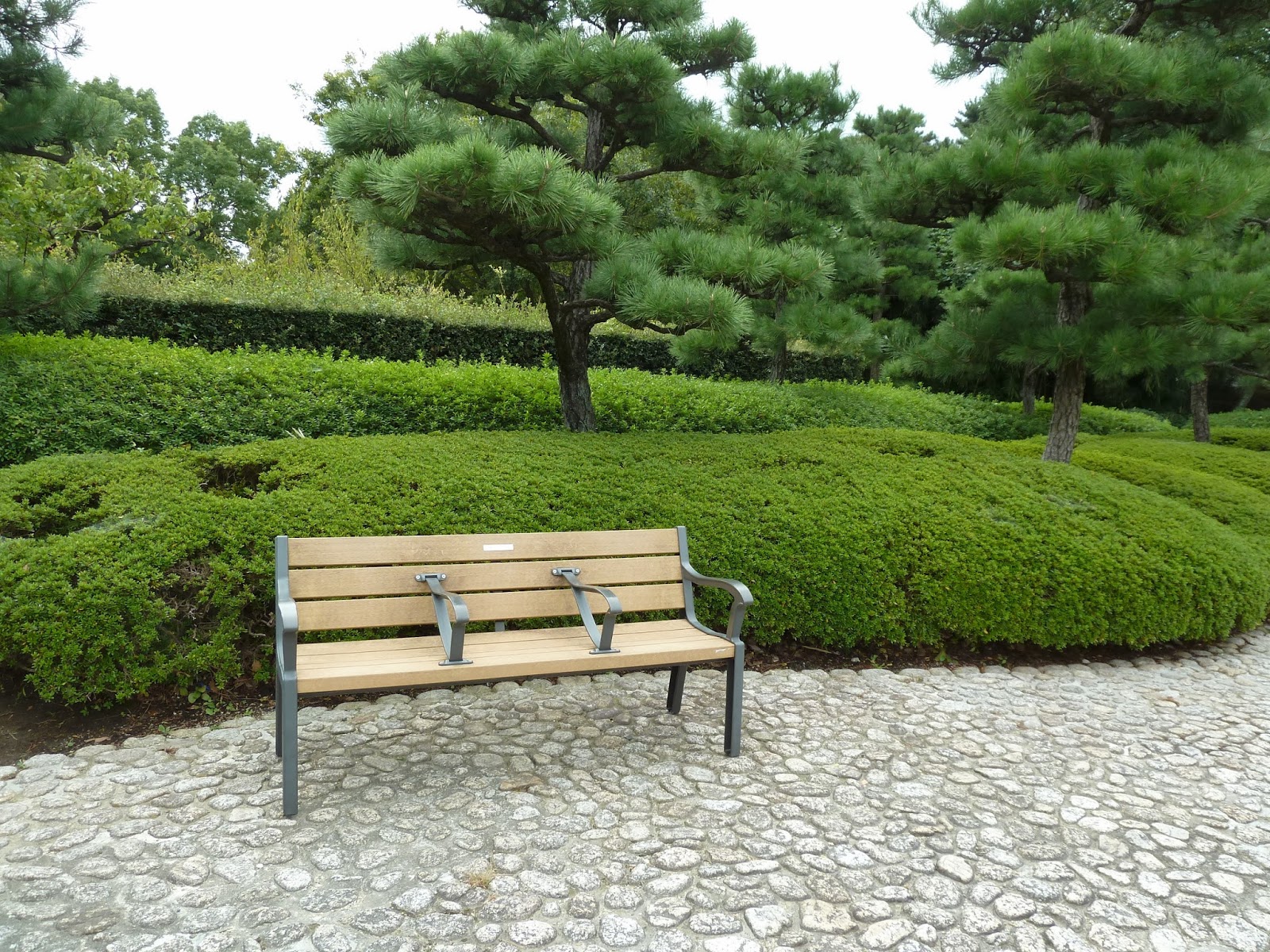
The grounds were beautiful and meticulously manicured, as you might expect any Japanese garden to be. And take a look at the bench below. Perfect type of bench for a public place because three people can comfortably sit together with the barriers between them. I feel like people, myself included, are uncomfortable if a public bench has more than two people on it. I feel like I'm too close to the people next to me, invading their personal space and having mine invaded as well. Too close for comfort. But somehow the arms in the middle of this bench would alleviate that discomfort.


The Nagoya Castle was first built in 1612, then restored in 1868. It became the first castle to be designated a national treasure in 1930, along with the Hommaru Palace which was originally built in 1615. Sadly, in May 1945, during WWII air raids on Nagoya, the main castle tower and many of the buildings including the Hommaru Palace were burned down and destroyed. The castle had served as the symbol of Nagoya for centuries, so the people rallied for the main castle to be rebuilt, which happened in 1959. Below is a picture of what the Castle and the Palace looked like before they were destroyed.


In the photo below is the southeast corner tower, one of the three corner towers that survived the fire. This one was used at one time to house weapons and also apparently has trap door from which large stones were dropped on enemies.


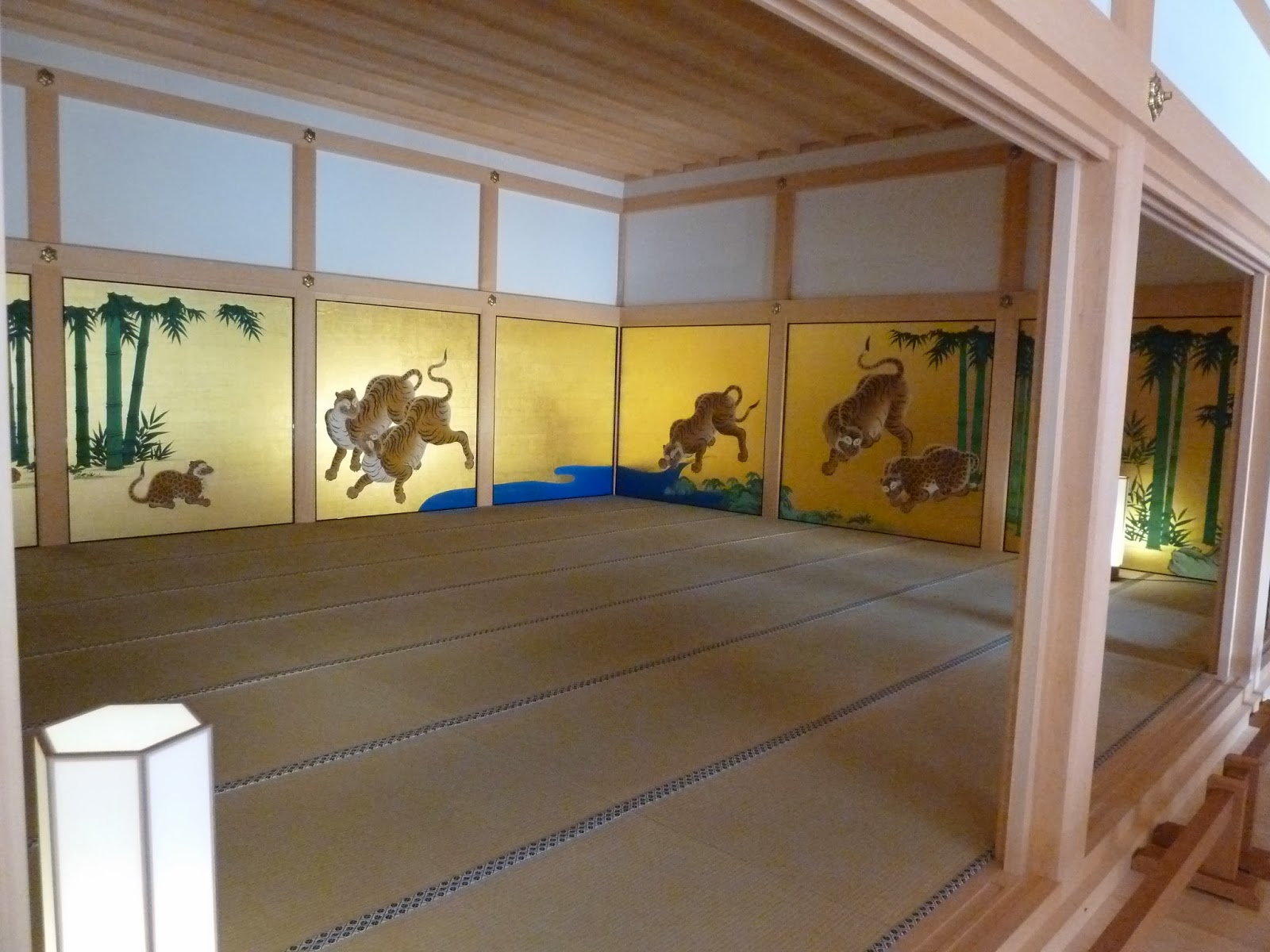
Efforts to rebuild the Hommaru Palace began in 2009. The entrance hall and main hall opened to the public just last May, five months before we visited. Still under construction in three phases, completion of the entire palace is expected for some time in 2018. Luckily, most of the paintings on the sliding doors of the original palace survived the fire and I believe they are being restored and installed in the palace as construction continues. 1,047 of these paintings have been designated by Japan as Important Cultural Assets.


The entrance, which is pictured below (along we me, Tara, and Jane) is called the Genkan. I think that means entrance or entrance hall in Japanese. It's made with a shingled roof consisting of thin slats of wood thickly stacked on top of each other. The black lacquered gable is adorned with metal fittings.


The beautiful light-colored wood inside is primarily hinoki cypress, I found out when I researched it after returning home.


The picture above on the left I think is a wall of names of those who have donated to the restoration project. I *think*, but of course I'm really not sure. And if you can't see in the one of the hallway above, the little sign says, "Mind your head."


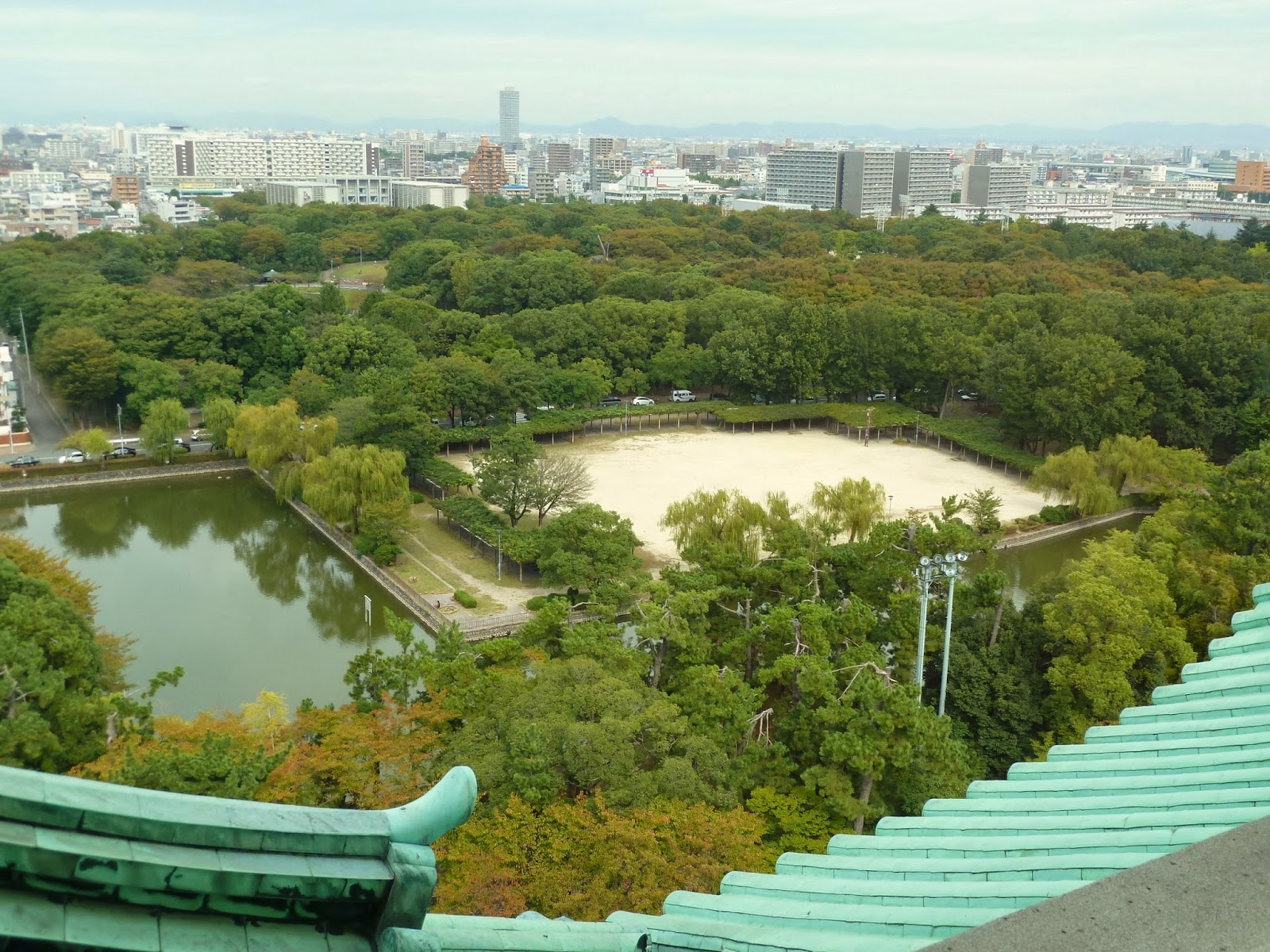
After changing back out of our Japanese slippers, which were required footwear while walking through the palace, and into our street shoes, we made our way over to the Castle and each of its eight levels, except for the special exhibit level 2, which we hadn't paid to see.


Of course, as is with any place that attracts tourists, there was a gift shop up on the observation deck level.


We were running out of time to get back to our designated group meeting spot, so we took the stairs all the way down. I felt like I was in a cage the whole time.


One thing I love about traveling, is observing how little old ladies are so similar no matter where in the world you are. Also make note that the benches they are sitting on do now have armrests in the middle. These ladies must be friends.


You may have noticed the golden fish looking statues on either side of the top of the main castle tower.


These are golden dolphins, kinshachi, imaginary animals that are said to be able to summon water and have come to be used as charms for preventing fire, which I think is rather sad seeing as the originals were destroyed in the fire from the wartime air raids. Nevertheless, we couldn't resist taking pictures on the life-size replicas. Don't worry, it was allowed. Encouraged, even.


Each is roughly 8.5 feet (2.6 meters) high and weighs 2700 pounds. The real ones are covered with nearly 6 inch-thick 18-carat gold. And apparently, the gold alone from one of these creatures weighs about 97 pounds. Pretty extravagant!

Still rushed for time, I ran over to the area where they were having a large bonsai tree exhibit. My guess is there were a least a couple hundred trees.


After leave the castle grounds, we got back on the subway and headed to the Osu Kannon Temple. I'm going to save that for Part Two, coming right up. I know this is a bit of a picture overload, but it will serve as a great memory for me.
.
.
.
.